Brooke N. Macnamara, Principal Investigator
Research
Broadly, we are interested in predictors of skilled performance variance. Predictors include experiential factors (e.g., training, practice), trait-level factors (e.g., cognitive abilities, emotion-cognition interaction traits), and environmental factors at multiple levels (barriers/opportunities, task characteristics).
Skilled performance variance includes both intra-individual change (skill acquisition, skill decay) and inter-individual differences in expertise and achievement. We are also interested in methodology and theories of achievement, including potential harms. The work broadly intersects with cognitive psychology, I-O psychology, affective science, and social psychology.
Members of the S.L.A.P. Lab research factors associated with learning, skill acquisition, achievement, and expertise.
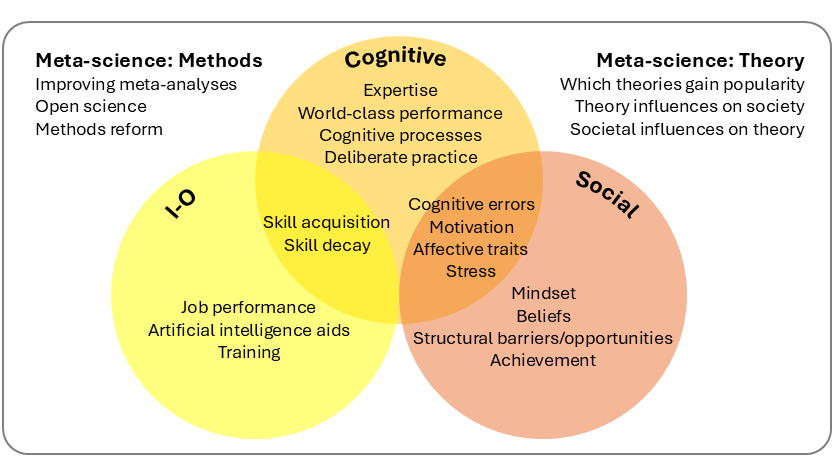
Our current and recent projects include examining:
– how types and amounts of experience predict individual differences in expertise,
– how various cognitive abilities predict individual differences in skilled performance,
– how beliefs predict achievement,
– how task characteristics interact with other factors to predict performance,
– stress and performance under pressure,
– the role of artificial intelligence on human skill, and
– emotion-cognition interaction traits on skill, learning, and performance.