Research
About Our Research
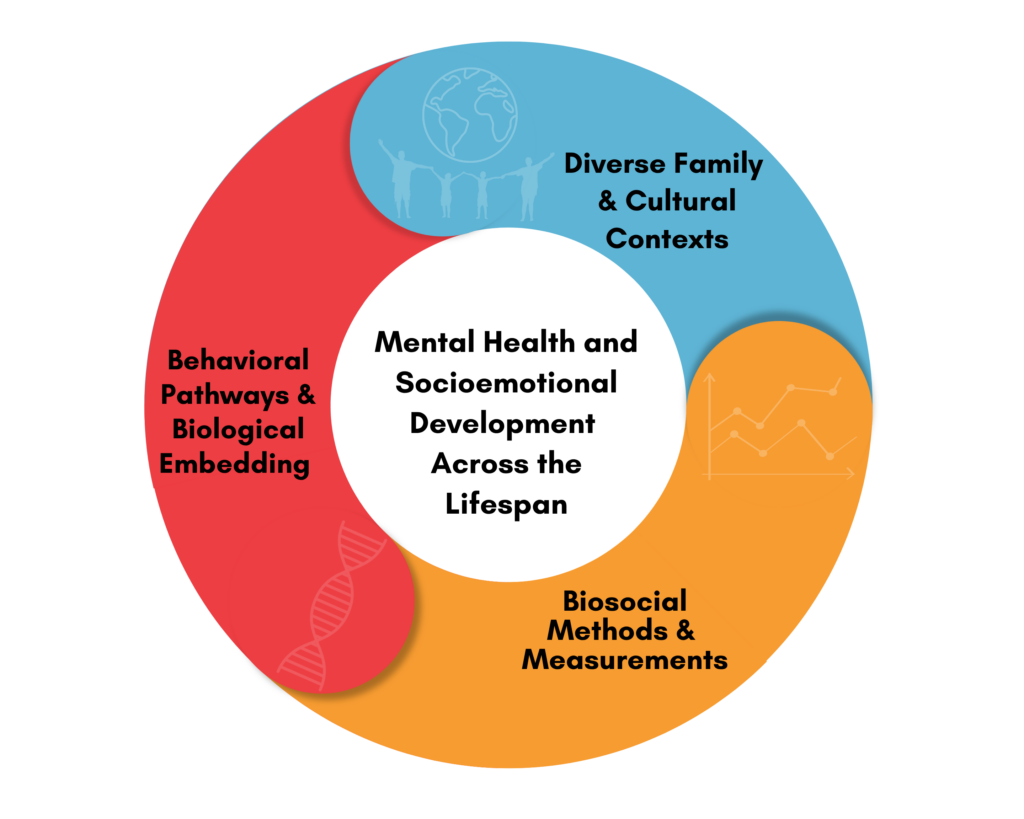
The BPsyDeC Lab asks a central question: How does early experience contribute to children’s socioemotional adjustment and risk for mental health difficulties, across diverse family and cultural contexts? We approach this question through three connected lines of research.
What We Study
Aim 1: Diverse Family and Cultural Factors in Young Children’s Socioemotional Adjustment
Our first line of research aims to examine how parenting behaviors and family environments shape children’s socioemotional development (e.g., emotion regulation and internalizing/externalizing behaviors) across diverse contexts.
Using behavioral observations of parent–child interactions, including moment-to-moment and intensive longitudinal data analysis, we have shown how mothers’ supportive behaviors and children’s emotions influence one another in real time, and how maternal depression can disrupt these dynamics. Our research also traces how childhood parental warmth relates to health across the lifespan by studying how fathers, parental stress, and emotion regulation difficulties shape children’s adjustment over time.
Culture is central to this work. Much of what researchers know about parenting and child development comes from Western, English-speaking families — a narrow slice of the world’s population. Our research broadens this picture by studying families in Hong Kong, mainland China, and other under-studied cultural contexts, as well as identifying culturally specific ways that parents shape children’s understanding of others’ minds and emotions. We have also contributed to a global research collaboration examining how the COVID-19 pandemic affected children’s mental health around the world.
Selected publications:
- Chan, M. H. M., Kathuria, T., Friedlmeier, W., Feng, X., & Kapadia, S. (2026) Maternal Emotion Socialization in Chinese, Indian, and European American Families: Socialization Goals as a Culturally Embedded Factor. Frontiers in Psychology, 17, 1772882. https://doi.org/10.3389/fpsyg.2026.1772882
- Chan, M. H.-M., Feng, X., Wang, Z., & Wang, L. (2026). Maternal Meta-Emotion Philosophy Across Cultures: How Beijing Chinese, Hong Kong Chinese, and European American Mothers Make Sense of Dismissing Children’s Negative Emotions. Journal of Cross-Cultural Psychology, 00220221251406548. https://doi.org/10.1177/00220221251406548
- Gong, Y., Wang, J., Chan, M. H., Xu, X., & Feng, X. (2026). Sentiment analysis of parent–child emotional co-regulation: The roles of child temperament. Emotion. https://doi.org/10.1037/emo0001739
- Foley, S., Ronchi, L., Lecce, S., Feng, X., Chan, M. H., Hughes, C. & i-FAM COVID-19 Consortium (2022). Cross-cultural equivalence of parental ratings of child difficulties during the pandemic: findings from a six-site study. International Journal of Methods in Psychiatric Research. https://doi.org/10.1002/mpr.1933.
Aim 2: Behavioral Pathways & Biological Embedding
Our second research aim is to investigate biological embedding, the process by which early social experiences get “under the skin” of children and shape long-term health and development, through epigenetic changes.
We study DNA methylation, a chemical marker on DNA that responds to the surrounding environment, as a biological embedding process. Using epigenome-wide analyses (EWAS) of DNA methylation from blood and cheek-swab samples, we have identified patterns linked to family stress in immune- and stress-related genes — findings that help clarify which biological samples are more informative for studying these processes in children. We are also examining how DNA methylation relates to both Black and White American children’s internalizing (e.g., anxiety, sadness) and externalizing (e.g., aggression, defiance) behaviors, to understand whether seemingly different mental health issues share a common biological signature. Our goal is to better understand DNA methylation in the context of race and ethnicity, and help move the field of epigenetic research toward a more diverse and culturally informed direction.
Selected publications:
- Chan, M. H.-M., Merrill, S. S., Zhuang, B. C., Lin, D. T. S., Macisaac, J. L., Miegakanda, V., Lew-Levy, S., Boyette, A. H., Kobor, M. S., & Gettler, L. T. (2026). Children’s DNA Methylation and Family Dynamics in a Congo Basin Subsistence Community: Links with Parental Conflict and Fathers’ Caregiving. bioRxiv. https://doi.org/10.64898/2026.06.15.732362
- Chan, M. H., Merrill, S. M., Fatima, F., MacIsaac, J. L., Obradović, J., Boyce, W. T., & Kobor, M. S. (2025). Cross-tissue specificity of pediatric DNA methylation associated with cumulative family stress. Developmental Psychobiology 67(6), e70097. https://doi.org/10.1002/dev.70097
- Chan, M. H. M., Merrill, S. M., Konwar, C., & Kobor, M. S. (2023). An integrative framework and recommendations for the study of DNA methylation in the context of race and ethnicity. Discover Social Science and Health, 3(1), 9. https://link.springer.com/article/10.1007/s44155-023-00039-z
Aim 3: Advancing Quantitative Rigor and Biosocial Research
Our third research aim is to strengthen the methodological foundation for biopsychosocial research.
By testing whether psychological measures work the same way across development and cultures, we seek to enhance the rigor and interpretability of research findings.
We also tackle key methodological challenges in social epigenetics: which biological tissues (blood, saliva, cheek cells) best reflect meaningful environmental exposures, and how to account for differing cell-type composition within a sample. This is a critical step for avoiding false conclusions in DNA methylation research.
Selected publications:
- Chan, M. H., Meijer, M., Merrill, S. M., Fu, M. P. Y., Lin, D., MacIsaac, J. L., Riis, J. L., Granger, D. A., Thomas, E. A., & Kobor, M. S. (2026). Not All Saliva Samples Are Equal: The Role of Cellular Heterogeneity in DNA methylation and Epigenetic Age Analyses with Biological and Psychosocial Factors. Psychoneuroendocrinology, 107688. https://doi.org/10.1016/j.psyneuen.2025.107688
- Chan, M. HM., Feng, X., Gong, Y.g, & Inboden, K.g (2025). Longitudinal changes in preschoolers’ self-reported psychological and social problems: Feasibility, reliability, and cross-informant agreement. Child Psychiatry & Human Development. https://doi.org/10.1007/s10578-025-01864-w
- Meijer, M., Fu, M. P. Y., Navarro-Delgado, E. I., Engelbrecht, H.-R., Turecki, G., Chan, M. H., & Kobor, M. S. (2026). Peripheral blood DNA methylation partially reports on immune cell type composition in the frontal brain. Brain, Behavior, & Immunity – Health, 56, 101316. https://doi.org/10.1016/j.bbih.2026.101316
Ongoing Projects
National Institute of Mental Health (NIMH) R01 grant (R01MH130442), Co-I
Childhood adversity, DNA methylation, and risk for depression: A longitudinal study of protective factors and sensitive periods in development
PI: Dr. Erin Dunn
We study the biological embedding of positive childhood experience through DNA methylation in the context of adversity using the Avon Longitudinal Study of Parents and Children cohort.
NIMH R01 grant (R01MH113930), Co-I
Childhood adversity, DNA methylation, and psychopathology symptoms: A longitudinal study of sensitive periods and chrono-epigenetics
PI: Dr. Erin Dunn
We study DNA methylation trajectories as a potential pathway from adversity to depression risk in the Drakenstein Child Health and Development Study.
Parental Emotion Socialization and Young Children’s Socioemotional Adjustment in Indian, Chinese, and European American families: The Role of Culturally-Embedded Factors
Selected publications:
- Chan, M. H. M., Kathuria, T., Friedlmeier, W., Feng, X., & Kapadia, S. (2026) Maternal Emotion Socialization in Chinese, Indian, and European American Families: Socialization Goals as a Culturally Embedded Factor. Frontiers in Psychology, 17, 1772882. https://doi.org/10.3389/fpsyg.2026.1772882
- Chan, M. H.-M., Feng, X., Wang, Z., & Wang, L. (2026). Maternal Meta-Emotion Philosophy Across Cultures: How Beijing Chinese, Hong Kong Chinese, and European American Mothers Make Sense of Dismissing Children’s Negative Emotions. Journal of Cross-Cultural Psychology, 00220221251406548. https://doi.org/10.1177/00220221251406548
Health risk and resilience in children living in rural, low-income communities: Biological factors and developmental timing (leveraging the Family Life Project)
Lean more about the Family Life Project
Selected publications:
- Chan, M. H., Meijer, M., Merrill, S. M., Fu, M. P. Y., Lin, D., MacIsaac, J. L., Riis, J. L., Granger, D. A., Thomas, E. A., & Kobor, M. S. (2026). Not All Saliva Samples Are Equal: The Role of Cellular Heterogeneity in DNA methylation and Epigenetic Age Analyses with Biological and Psychosocial Factors. Psychoneuroendocrinology, 107688. https://doi.org/10.1016/j.psyneuen.2025.107688
Collaborators
- Dr. Erin Dunn – Purdue University, USA
- Dr. Kristine Marceau – Purdue University, USA
- Dr. Sarah Merrill – University of Massachusetts Lowell, USA
- Dr. Wolfgang Friedlmeier — Grand Valley State University, USA
- Dr. Lee Gettler — University of Notre Dame, USA
- Dr. Mandy Meijer – University of British Columbia, Canada
- Dr. Michael Kobor — University of British Columbia, Canada
- Dr. Thomas Boyce — University of California, San Francisco (UCSF), USA
- Dr. Nicole Bush — University of California, San Francisco (UCSF), USA
- Dr. Claire Hughes — University of Cambridge, United Kingdom
- Dr. Li Wang — Peking University, China
- Dr. Zhenlin Wang — Massey University, New Zealand
News/Media
- Featured on the HHS News at Purdue (“Symphony of cells: Purdue human development and family science researcher connects culture, behavior, and biology to bridge social-emotional development with epigenetics”)
- Featured on the “5-minute Psychology” podcast (“Adult Attachment style”)
- Featured on Neuroscience News (“Contagious Yawning More Closely Associated With Perceptual Sensitivity Than Empathy”)
- Featured on Science Daily (“Contagious yawning more closely associated with perceptual sensitivity than empathy”)