Newsletters
Learn more about what is happening in the Early Learning Community! Navigate through each article in a newsletter using the menu located on the left side of your screen.
Director’s Message
Dear Center for Early Learning friends, affiliates, and community,
Welcome to the first edition of our new Center for Early Learning (CEL) newsletter!
It’s been an exciting year for CEL starting with our new strategic planning process where we connected with campus and community partners to set the course for the next several years of our growth. We now have more than 35 faculty affiliates from across six college on campus, dozens of graduate student and postdoctoral affiliates, and a growing group of community partners—all with a focus on enhancing the educational opportunities, quality of life, and broader success of children, families, and their communities.
Our executive leadership team is working hard to implement the new strategic plan by expanding our research advancement opportunities, translating research to practice in ways that directly benefit our communities, creating research practice partnerships, extending the Early Learning Matters curriculum into new spaces, and bringing together community partners in ways that advance access and quality of early learning opportunities that build off the best research evidence. We’ve continued to turn donor support into impactful outcomes through providing faculty seed grants to advance interdisciplinary applied research, graduate student dissertation and teaching awards, and a newly announced community partnership development funding award.
In this issue, we’re excited to share with you more on the events, activities, and opportunities that are happening through CEL. You’ll also have a chance to learn more about a faculty affiliate and a CEL alumna, as well as scientific advancements made through one of our donor-supported research awards. We’d also love to hear from you on the needs of the community or questions you have about how to support early learning wherever you are.
This year has been a busy time for CEL, and we’re hopeful for continued partnerships with you and others. We’re grateful for your partnership and look forward to working with all of you in our community in the Persistent Pursuit of the Next Giant Leap. Here in CEL, we recognize that Giant Leaps Start with Little Feet!
Sincerely,
David J. Purpura
Director, Center for Early Learning
Professor, Human Development and Family Science
Purdue University
Connecting the Dots: How Indiana’s Early Learning Community is Building a Brighter Future Together
On Friday, October 24, 2025, the air inside the MatchBOX Co-Working Studio in Lafayette was buzzing with energy, ideas, and a shared sense of purpose. A wonderfully diverse group of over 30 individuals came together for a strategic workshop titled “Advancing Early Childhood Education in Indiana.”
Facilitated by the team at Saath Partners, the workshop brought together early childhood educators, community organizers, public school superintendents, business leaders, university researchers, and local policymakers. From West Lafayette Mayor Erin Easter and school superintendents to local child care providers and Purdue academic leaders, everyone had a seat at the table.
This gathering wasn’t just a one-off meeting; it was the culmination of a community-wide effort. To prepare, participants filled out an in-depth pre-workshop survey sharing their front-line insights. Combining those survey results with the live feedback from our breakout tables, the team has been busy building a comprehensive final report and an interactive “systems map” to guide our next steps.
Seeing the Whole Picture: The Indiana ECE Systems Map
If you’ve ever felt like early childhood education (ECE) is a giant jigsaw puzzle with too many missing pieces, you aren’t alone. One of the highlight activities of the workshop was diving into a “Systems Map” (or what we like to call our “rich picture”) designed to show how all the different parts of early learning connect in Indiana.
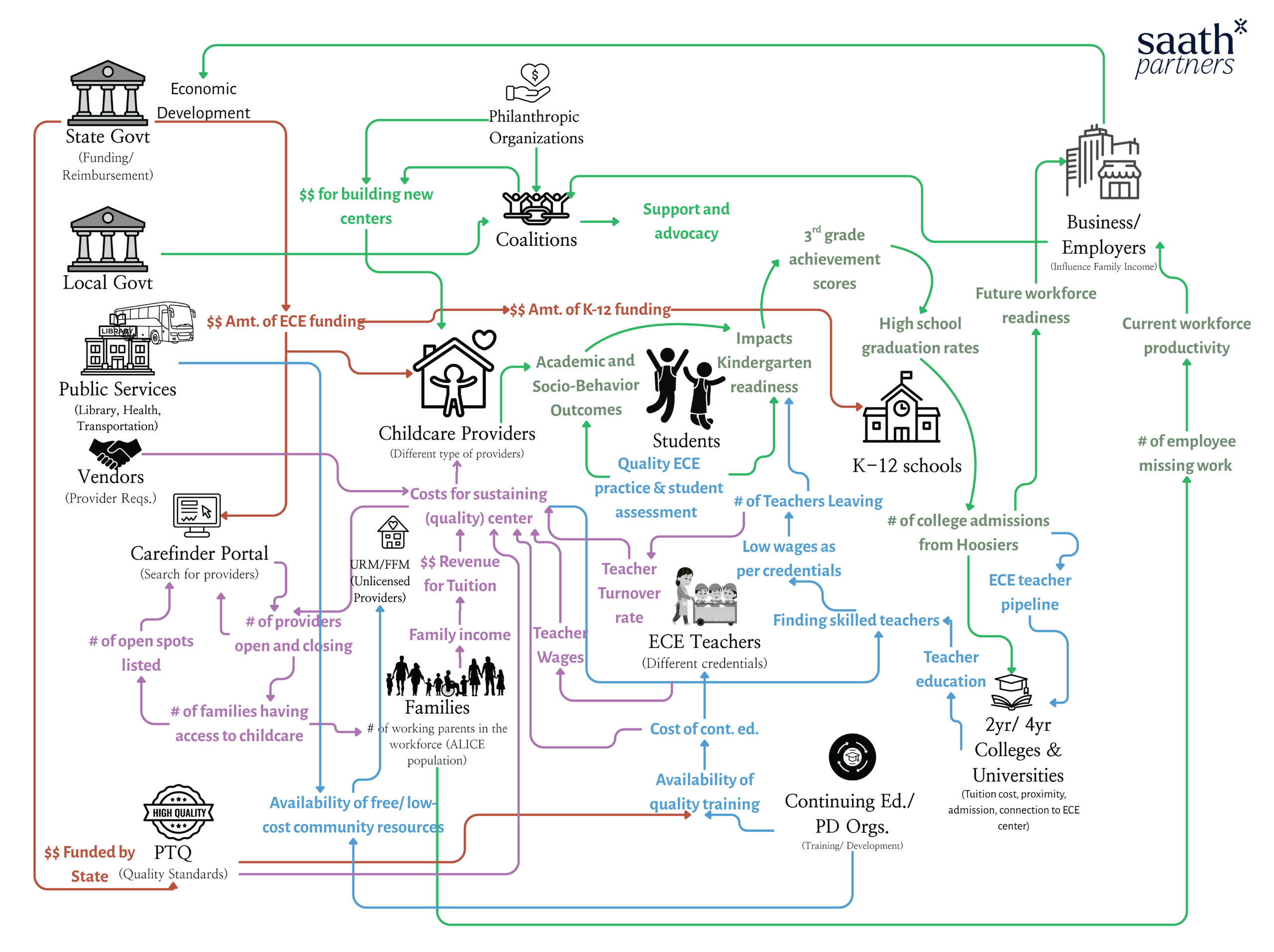
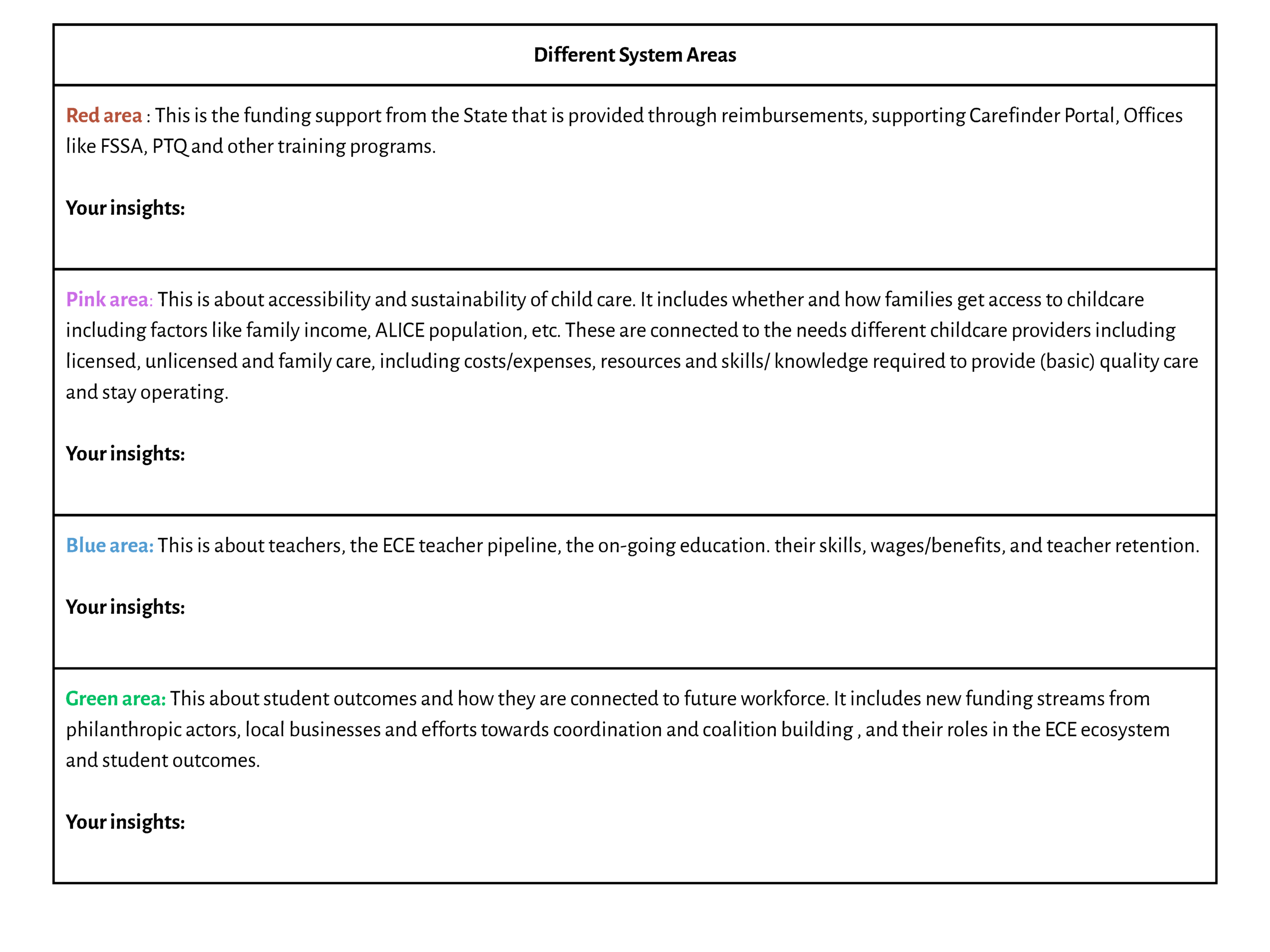
Rather than looking at child care as just a single program, the map breaks the ecosystem down into four interconnected, color-coded neighborhoods:
- The Red Zone (State Funding & Standards): This is the foundation of public support, including state reimbursements, quality standards like Paths to QUALITY (PTQ), and navigation tools like the Carefinder Portal.
- The Pink Zone (Access & Sustainability): Focused directly on families and providers. It looks at what it takes for a family to afford care—especially families in the ALICE (Asset Limited, Income Constrained, Employed) population—and what providers need to keep their doors open.
- The Blue Zone (Our Incredible Teachers): Dedicated entirely to our workforce. It covers the teacher pipeline, ongoing professional development, college degree pathways, and the critical need for better wages and benefits to keep great teachers in our classrooms.
- The Green Zone (Outcomes & Future Workforce): Connecting the dots between early learning, K-12 academic and social success, and Indiana’s future economy. It also highlights the powerful role of philanthropic organizations and local businesses in supporting community coalitions.
The big takeaway? Everything is connected. When a teacher leaves the field because of low wages (Blue), a classroom closes, which reduces available spots for working parents (Pink), which ultimately impacts local businesses trying to hire staff (Green).
Celebrating Our Momentum: What’s Already Working
It is easy to get overwhelmed by the challenges, but our workshop tables spent time celebrating some truly incredible work happening right here in our communities:
- Active Coalitions: Almost every county now has an active coalition dedicated to early childhood education, showing that local leaders are ready to collaborate.
- Creative Classrooms and Pipelines: Programs like the Greater Lafayette Career Academy and Ivy Tech are partnering to help high schoolers earn dual credits and complete their Child Development Associate (CDA) credentials, fueling a new generation of educators.
- Employers Stepping Up: Businesses are beginning to realize that child care is an economic issue, not just a family one. For instance, Subaru’s on-site child care center was highlighted as a stellar example of an employer investing directly in their workforce’s peace of mind.
- Philanthropic Support: Generous funding, such as Lilly Endowment grants, is allowing communities across Indiana to pilot exciting, local solutions.
Balancing the Scales: Navigating our Shared Tensions
Of course, honest conversations require talking about the hard stuff. Our breakout groups identified several ongoing “tensions” that we have to balance:
- Quality vs. Affordability: How do we provide top-tier, developmentally rich care while keeping tuition affordable for hard-working families?
- Workforce Expectations vs. Reality: We expect early educators to hold high credentials and provide excellent instruction, yet their wages often do not reflect the professional value they bring to our society.
- Local Innovation vs. Statewide Alignment: Brilliant ideas are happening n pockets all over the state, but we lack a unified “North Star” or centralized network to easily share these successes across counties.
- Fragmented Data: Tracking a child’s progress from early childhood into K-12 is currently a challenge because our data systems don’t easily talk to one another.
How the Center for Early Learning (CEL) is Stepping Up
At the Purdue Center for Early Learning, we took all of this feedback to heart. We want to be an active, supportive partner—serving as a backbone, an integrator, and a helping hand for all of you. Moving forward, CEL is focusing its strategic plan on five key areas:
- Advancing Practical Research: Answering the real-world questions that teachers, parents, and community leaders are asking.
- Co-Designing Innovation: Working alongside educators and families to design, test, and share research-backed tools like books, games, and learning activities.
- Strengthening Teacher Connections: Utilizing the Early Learning Matters (ELM) curriculum framework to support peer mentoring, coaching networks, and on-the-ground professional development.
- Translating Science into Simple Tools: Creating easy-to-use guidebooks, policy briefs, and “Return on Investment” templates so local coalitions can easily make their case to businesses and legislators.
- Convening Partners Statewide: Serving as a statewide connector so local coalitions can stop reinventing the wheel and start learning from one another.
Moving Forward
As the workshop came to a close, David Purpura, Sarah Eason, and Chanele Robinson-Rucker led the room in a collective reflection. When asked to write down one word describing how they felt leaving the session, the screen filled with words like inspired, hopeful, energized, and motivated.
Early learning in Indiana is at a turning point. We have the data, the passion, and the people. By continuing to talk, collaborate, and move together in the same direction, we can ensure that every child in Indiana gets the strong start they deserve.
Thank you to everyone who lent their voice, time, and heart to this workshop. We can’t wait to take the next steps with you!
Helping Struggling Readers Thrive
For a child who struggles to read, summer can provide a critical opportunity to build skills and confidence. Yet across Indiana, too many children are falling behind. In 2024, 35% of Indiana fourth graders had below basic proficiency on grade-level reading standards. Our project is working to change that one child at a time, while building the evidence needed to expand access to effective reading support.
Research that directly serves our community
The SOLAR project—or Summer Opportunities for Literacy Achievement Research—began with a Center for Early Learning Seed Grant in December 2025. Supported by CEL, this interdisciplinary project brings together expertise in human development, language, literacy, and clinical practice. The research is led by Dr. Chenell Loudermill, Clinical Professor of Speech, Language, and Hearing Sciences and Dr. Rebecca Marks, Assistant Professor of Human Development and Family Science. Dr. Loudermill directs the Purdue Literacy Education & Practice Project (Purdue-LEaPP), where student clinicians provide supervised intensive summer intervention to children with language-based learning disabilities. Together, Drs. Loudermill and Marks will apply a rigorous randomized control trial (RCT) design to assess the summer reading trajectories of children who do and do not receive intervention.
During summer 2026, CEL Seed Funding enabled piloting of the research strategy with three children: two with dyslexia and one average reader. Testing at the beginning and end of summer (May and August) helped to refine measurement and prepare for larger-scale data collection. The funding also supported detailed documentation of the six-week intervention, creating the foundation for reproducible research, and successful Institutional Review Board approval for a larger RCT study beginning in 2027.

Building for the future
The next phase of the project will examine two important questions. First, how do children’s reading skills change during intensive summer intervention? Second, how do these hands-on clinical experiences affect the knowledge and clinical competence of future speech-language pathologists?
This work is already expanding opportunities for local learners. Building on the foundation created by the seed grant, the team secured $15,000 from the Indiana Clinical-Translational Sciences Institute (CTSI) to support the next two years of research and provide free clinical services to 24 participating children: 12 receiving immediate intervention in summer 2027, and 12 control participants who will receive delayed intervention during the school year.

The Center for Early Learning’s investment has helped turn a small clinical training program into the foundation for a larger research-practice partnership that combines rigorous research with direct service to children and families in our community.
Faculty Affiliate Spotlight: Dr. Breanya Hogue
Cultivating Community, Culture, and Literacy through the Purdue Freedom School
Name: Dr. Breanya Hogue
Title/Role: Assistant Professor of Literacy & Language Education; Executive Director of the Purdue Freedom School at First Church
Department: College of Education, Department of Curriculum & Instruction
Affiliation: Center for Early Learning Faculty Affiliate
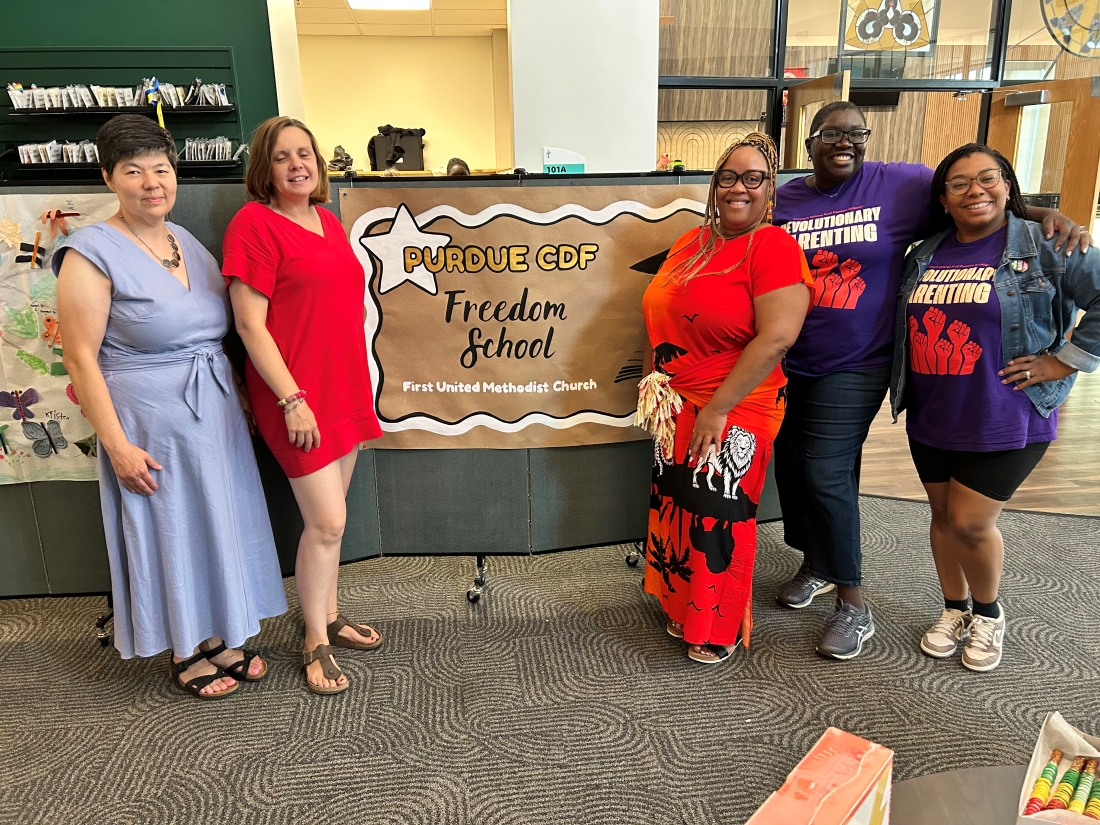
The Center for Early Learning (CEL) is proud to feature Dr. Breanya Hogue. As an Assistant Professor of Literacy & Language Education and the Executive Director of the Purdue Freedom School at First Church, Dr. Hogue’s work beautifully illustrates the profound impact of university-community partnerships.
Her community-engaged research and passion for culturally responsive education are reshaping how we think about out-of-school literacy programming, teacher preparation, and early learning systems.
Empowering Scholars and Families: The Purdue Freedom School
At the heart of Dr. Hogue’s current work is the Purdue Freedom School at First Church. Operating as a free six-week summer academic and literacy enrichment clinic, the school serves 60 local K–8 youth (affectionately referred to as “scholars”) and their families.
The program provides a holistic environment that addresses both educational and developmental needs. While scholars engage in enriching literacy activities, their parents and caregivers are supported through weekly workshops designed to address various academic, social, and well-being topics.
The confidence that K-8 participants gain in six short weeks, along with their reading progress, is something people might be surprised to learn about our work. It is an incredibly powerful transformation to witness.
~Breanya Hogue
Beyond the Basics: The Freedom School Model
What makes the Freedom School model so successful? According to Dr. Hogue, the magic lies in how literacy is defined and practiced. Rather than focusing solely on the technical skills of reading, the Freedom School Model:
Centers the voices of the scholars, ensuring they feel seen, heard, and valued.
Integrates multimodal learning, utilizing play, oral communication, and creative written expression.
Combats summer learning loss by keeping youth actively engaged in a supportive, joy-filled, and culturally relevant learning community.
This approach offers an enriching space for marginalized participants, proving that literacy development thrives when it is embedded in culture, play, and community.
Preparing Culturally Responsive Educators
The impact of the Purdue Freedom School extends far beyond the K–8 scholars; it serves as a vital training ground for the next generation of educators.
Undergraduate and graduate students at Purdue are trained and supported to meet the developmental needs of the scholars. By working directly in the clinic, pre-service teachers gain invaluable, real-world experience in culturally responsive pedagogy. Dr. Hogue views this as a vital model for teacher preparation programs nationwide, demonstrating how universities can successfully collaborate with community agencies to address urgent local needs.
This work is deeply personal for Dr. Hogue. Her own career path was shaped by a similar experience:
I was a former college worker—a Servant Leader Intern—as an undergraduate early education major. That experience completely transformed my teaching pedagogy and approach, ultimately drawing me to this field of research.
~Breanya Hogue
Looking to the Future of Early Learning Systems
When looking ahead at the next 5 to 10 years, Dr. Hogue sees incredible opportunities for improving early childhood and youth systems. She is particularly excited to explore:
Sustainable funding models to keep these vital community clinics free and accessible.
Effective coaching strategies for undergraduate education majors working within the clinic to ensure they are fully equipped for their future classrooms.
Innovative training and parent-engagement strategies that strengthen the bridge between home, school, and university.
An Interdisciplinary Celebration
While literacy is the cornerstone of the Purdue Freedom School, Dr. Hogue emphasizes that the program’s success relies on interdisciplinary collaboration.
“Though this is primarily a literacy-focused initiative, our afternoons are dedicated to a multitude of activities from various disciplines,” Dr. Hogue shares. She extends her sincere appreciation to:
The Mathematics Education Faculty (Drs. Kenney, Bofferding, and Kasteberg) for leading engaging hands-on STEM activities for the scholars each summer.
Dr. Loudermill for partnering to administer critical literacy pre- and post-screeners, helping track and support the scholars’ academic growth.
To learn more about Dr. Breanya Hogue’s research, or to discover how you can support or get involved with the Purdue Freedom School at First Church, please contact her at bhogue@purdue.edu.
Alumni Spotlight: Dr. Mackenna Vander Tuin
From transcribing research videos to leading early mathematics research in higher education.
Name: Dr. Mackenna Vander Tuin
Current Role: Assistant Professor of Childhood Education
Institution: University of Arkansas, College of Education & Health Professions (Department of Childhood Education)
Purdue Affiliation: Center for Early Learning Alumna

The Center for Early Learning (CEL) is delighted to reconnect with alumna Dr. Mackenna Vander Tuin. Currently serving as an Assistant Professor of Childhood Education at the University of Arkansas in Fayetteville, Mackenna is translating her passion for early childhood development into meaningful, evidence-based practices that support young learners, families, and future
teachers alike.
Making Math Accessible: Tears-Free Learning at the Dining Room Table
At the University of Arkansas, Dr. Vander Tuin’s research focuses on a critical yet often overlooked area of early childhood development: early mathematics. Specifically, she works to support early and elementary students (from birth through third grade) who are at risk for mathematical difficulties.
Her work approaches this through practical, highly engaging interventions, including:
- Mathematics Vocabulary: Equipping children with the language they need to understand mathematical concepts.
- Storybook Interventions: Integrating math learning naturally into shared reading experiences.
- Teacher Preparation: Training preservice teachers to implement evidence-based mathematical practices to support all students.
When asked about the goal of her academic work, Dr. Vander Tuin’s answer is grounded in the daily lives of families:
I hope to make math more accessible for families, teachers, and children. If I can help there be fewer tears at one dining room table or in a classroom, I will feel very accomplished.
~Mackenna Vander Tuin
Lessons in Humility: Stepping Down from the “Ivory Tower”
Reflecting on her time at Purdue, Dr. Vander Tuin carries two foundational lessons with her into her current practice as an Arkansas professor.
-
Value the Experts on the Ground:
“As a teacher, treat the caregivers and parents as the experts they are. As a researcher, treat the teachers as the experts they are. Essentially, value the expertise of the people closest to children and step down from your ivory tower.” -
The power of Mentorship:
She credits her mentor, Dr. David Purpura, for sparking and encouraging her initial interest in early mathematics research—a mentorship that continues to inspire her collaborative approach today.
She also carries the core perspective she adopted at Purdue: that learning begins long before a child ever steps into a classroom. “During my time at Purdue, I came to appreciate that learning begins long before children enter school, making the early years a critical foundation for lifelong learning.”
Looking Ahead and Giving Back
To strengthen the field of early childhood education over the next decade, Dr. Vander Tuin hopes to see a major shift in systemic support, advocating for more licensed educators, better funding in the preschool space, and a greater overall societal emphasis on early childhood intervention.
To current Purdue students who are wondering what steps to take next, she offers a simple, encouraging piece of advice:
Take advantage of research opportunities! Even if you’re unsure it’s the right path for you. It provided me with experiences, mentors, and skills that shaped my career and life!
~Mackenna Vander Tuin
The Center for Early Learning is incredibly proud of Dr. Vander Tuin’s work and her dedication to making early math a joyful experience for children and families. To connect with Mackenna or learn more about her research, you can reach her at mvander1@uark.edu. Boiler Up!